
- Home
- Investing
- Stocks
Market valuations are at levels that have historically preceded long, flat stretches. Here's why that matters for your retirement and what to consider as potential solutions.
 By
Mike Decker, NSSA®
Published
6 July 2026
In
Features
By
Mike Decker, NSSA®
Published
6 July 2026
In
Features
When you purchase through links on our site, we may earn an affiliate commission. Here’s how it works.
 (Image credit: Getty Images)
- Copy link
- X
You know the story. A boy keeps shouting that there's a wolf, nobody comes, and the one time a wolf actually shows up, he's on his own.
For the past several years, financial commentators have been pointing at market valuations and warning that stocks are expensive. And for the past several years, the market has largely ignored them and kept climbing.
Past performance may not indicate future returns, but it does skew our expectations. This is especially true right now, because the past 15 years have been incredible, favoring those who took on more risk than they may have realized.
From just $107.88 $24.99 for Kiplinger Personal Finance
Become a smarter, better informed investor. Subscribe from just $107.88 $24.99, plus get up to 4 Special Issues
CLICK FOR FREE ISSUE
Sign up for Kiplinger’s Free Newsletters
Profit and prosper with the best of expert advice on investing, taxes, retirement, personal finance and more - straight to your e-mail.
Profit and prosper with the best of expert advice - straight to your e-mail.
Sign upAbout Adviser Intel
The author of this article is a participant in Kiplinger's Adviser Intel program, a curated network of trusted financial professionals who share expert insights on wealth building and preservation. Contributors, including fiduciary financial planners, wealth managers, CEOs and attorneys, provide actionable advice about retirement planning, estate planning, tax strategies and more. Experts are invited to contribute and do not pay to be included, so you can trust their advice is honest and valuable.
After a while, you stop listening to the warnings. That's the dangerous part of the fable. The boy was wrong several times. But in the end, there was a wolf.
The data tells a story worth hearing
The Shiller P/E ratio (CAPE) divides the S&P 500's price by its average inflation-adjusted earnings over the prior 10 years. As of mid-2026, it sits at roughly 41, which is a level exceeded only by the dot-com peak.
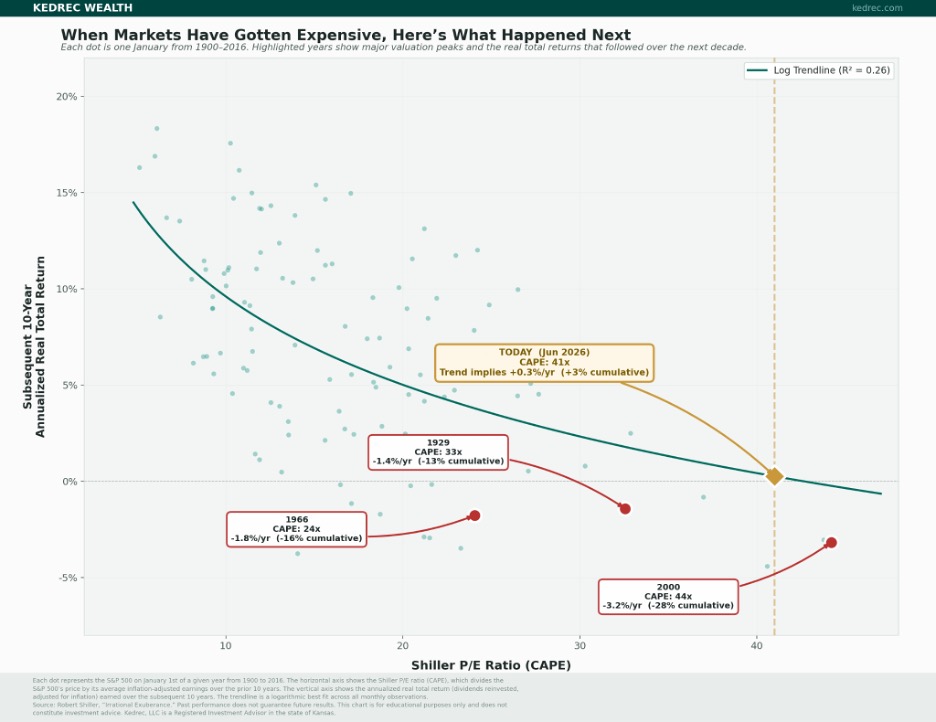
Each dot in the chart above represents the S&P 500 on the first trading day of a given year, plotted against the real total return investors earned over the following decade. The pattern is clear: Every time valuations have reached these levels — 1929, 1966, 2000 — the subsequent decade delivered flat or negative real returns.
Not every time was a crash. But every time was a long, frustrating stretch of going nowhere.
I wrote about this pattern in my article Four Historical Patterns in the Markets for Investors to Know. Historically, the market has gone flat for 10 or more years roughly every 20 years or so. We're now 16 years from the last one.
Innovation is real: Bubbles are, too
To be clear, this isn't a call to sell everything and hide in cash. New technologies, such as the railroad, the automobile and the internet, created genuine, lasting economic value. AI will likely do the same.
The problem isn't the innovation. The problem is what happens when everyone wants in at the same time.
Railroads were revolutionary. The railroad bubble of the 1840s still wiped out investors. The internet changed the world. The Nasdaq still fell about 78% from 2000 to 2002. Good technology and bad timing can coexist.
The flip side is just as important
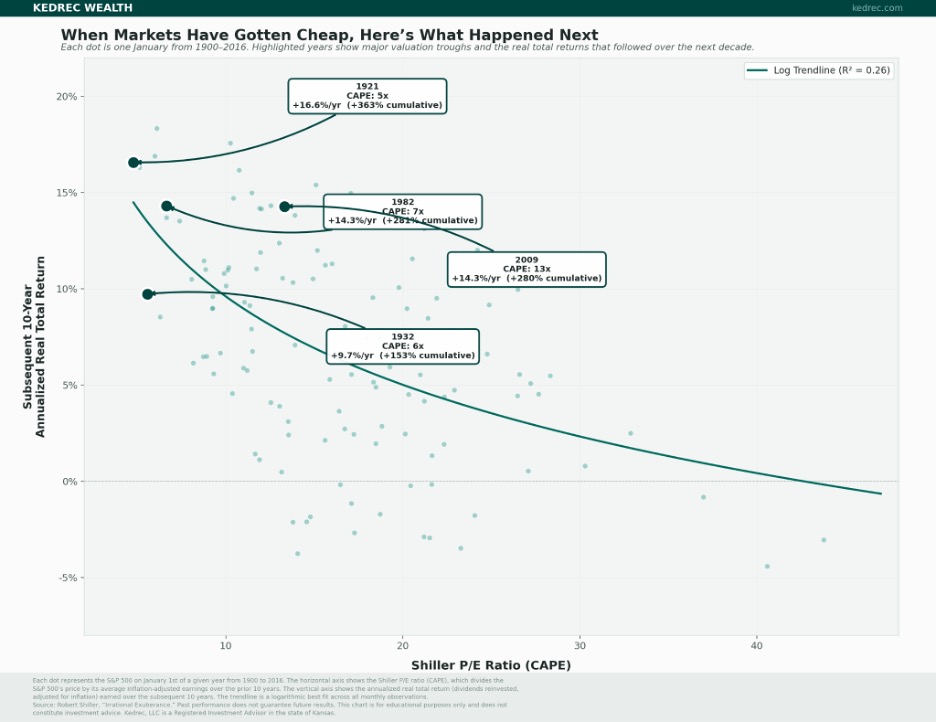
This chart tells the mirror story. At the end of every flat-market cycle — 1921, 1932, 1982, 2009 — valuations were depressed, and the subsequent decade rewarded patient investors handsomely.
This is one of the reasons I wrote my book, How to Retire on Time. I fear that too many people believe they can retire and use the same systems they have used for the past 15 years.
It's easy to retire when the markets only go up. It's a completely different story when the markets go flat.
If you consider that retirement may be 20 to 30 years, there's a good chance a part of your retirement could be during a flat-market cycle.
Looking for expert tips to grow and preserve your wealth? Sign up for Adviser Intel, our free, twice-weekly newsletter.
What that means in practice
It's not about trying to time each crash with active trading. It's not about riding the market up and down with your fingers crossed. It's about understanding price, recognizing when the market is offering a good deal and when it isn't and having a strategy that responds accordingly.
Patience is the foundation.
Beyond that, it means looking at tools that many investors overlook. Guaranteed income from an annuity can help stabilize your plan and portfolio, even if your stock portfolio doesn't perform (see the DIY Annuity Guide).
Bond funds may be making a comeback as an uncorrelated market to help stabilize your portfolio.
Real estate (not a stock of real estate companies, but something tied to actual real estate) can provide income and diversification that equities simply can't replicate.
It is important to take a step back as you approach retirement, or any new phase of life, and consider updating your plan. Perhaps it's time to diversify not just by asset class, but by markets and by strategies.
Here's the challenge: Many of these alternative strategies aren't readily available to retail investors through a standard brokerage account. That's one reason it may be worth sitting down with a fiduciary financial planner who can provide access to a broader set of tools, even if it's just a one-time engagement to build a plan you can execute yourself.
The wolf may or may not be at the door. But the shepherd who has a plan doesn't need to panic either way.
Related Content
- Bull Markets vs Bear Markets: The Differences Explained
- How to Spot a Bubble in Stocks
- How to De-Risk Your Portfolio in 5 Different Scenarios
- The Bear Market Protocol: 3 Strategies to Consider in a Down Market
- Four Historical Patterns in the Markets for Investors to Know
This article was written by and presents the views of our contributing adviser, not the Kiplinger editorial staff. You can check adviser records with the SEC or with FINRA.
TOPICS Adviser Intel Get Kiplinger Today newsletter — freeContact me with news and offers from other Future brandsReceive email from us on behalf of our trusted partners or sponsorsBy submitting your information you agree to the Terms & Conditions and Privacy Policy and are aged 16 or over.Mike Decker, NSSA®Social Links NavigationAuthor, Wealth Planner and Money Manager, Kedrec LLCMike Decker, NSSA®, is the founder of Kedrec Wealth, a flat-fee financial planning firm that offers one-time services or ongoing management for a fixed monthly fee. He is also the creator of Cash Flow and Capital, an app designed to help people develop a healthier relationship with money by improving awareness around spending and decision-making. Mike is the author of How to Retire on Time, How to Prepare to Retire on Time (coming soon) and The Bear Market Protocol (also coming soon). He shares practical retirement and wealth-building strategies through his podcast, weekly newsletter and two YouTube channels.